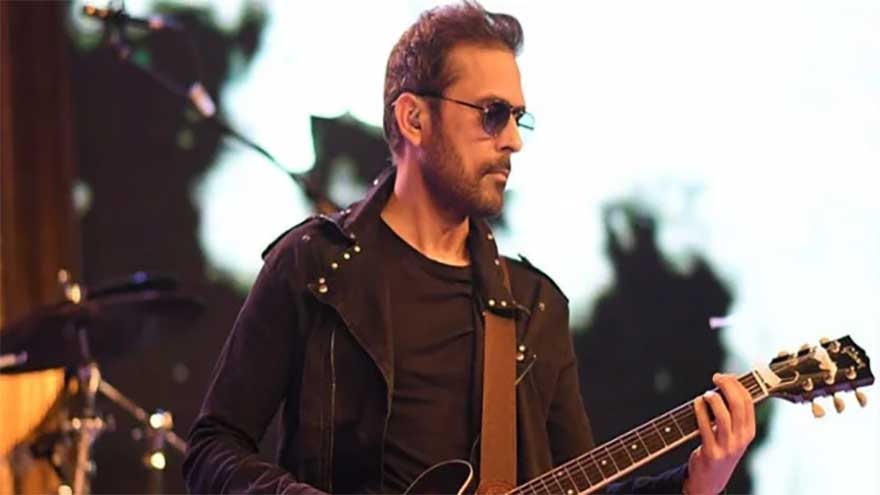

Salman Ahmed is a busy man. He launched his biography, Rock ‘n’ Roll Jihad, last month and is currently caught up with a book tour and holding talks on music, Sufism and jihad. En route to India, he stopped for a very short while in Pakistan, and took time out to answer some questions.
The founder, lead guitarist, (now) solo vocalist and front man for one of the biggest rock outfits to come out of Pakistan’s music industry, Salman Ahmed has come a long way in the 25 years since the band first came into existence. From playing in a friend’s garage in America to becoming a goodwill ambassador for the UN, collaborating with Morten Harket and Mellissa Ethridge on a song, and lecturing at a university in New York, Salman Ahmed’s life has been far from ‘predictable’.
And he’s documented all of it in his biography. ‘It took me four long and lonely years to finish (writing) this book,’ he said, adding that, ‘Through (out) my life people have wondered why I chose passion over profession, music over medicine and led an unconventional lifestyle. I felt that Rock ‘n’ Roll Jihad would set the record straight… at least for now.’
Considering that this is the first book to come out of the mainstream music industry in Pakistan — where proper documented information on the industry itself isn’t readily available — and differences of opinion, regarding facts and/or version of events quoted are bound to happen among the artistes, was he concerned about the kind of feedback he would receive from the community? ‘Not really,’ Salman responded, ‘I’ve always followed my heart and my book tells stories of musical kinship, a spiritual quest and cross-cultural journeys. It’s a wide-angle view of Pakistan, India and America and I’m playing the role of the literary view finder… people can interpret the book as they wish.’
‘So far I’ve gotten some very encouraging responses from diverse people,’ he adds. He mentions Stanley Wolpert (author of Jinnah of Pakistan) and Krist Novoselic (of Nirvana) who ‘has reviewed it for The Seattle Weekly while Deepak Chopra has recommended it on his website.’
The book is also currently available in bookstores in Pakistan. Salman hopes that ‘young people will find the book inspiring, encouraging and uplifting and are encouraged to follow their dreams with an uncompromising passion.’
There were several questions that came to mind when reading the book regarding Salman’s projection of the artistes he has worked with. But when responding he prefers to skirt the specific issue being questioned and gives a very vague response.
For example, in the book he mentions discovering Ali Azmat as a ‘wedding singer’ when the crooner was a part of a band called Jupiters. In the book we are given the impression that Salman mentored Ali but when asked specifically that whether the time Ali spent with Junoon helped him to evolve into the artiste that he is today, Salman responds, ‘God gave us all the opportunity of following our passion for music. I hope that we have all evolved for the better, both as artistes as well as human beings. It’s important to live a holistic and balanced life and be at peace with the world and ourselves.’
Wise words, but they don’t give an indication of what he thinks of the crooner’s artistic capabilities.
Also throughout the book, we only see how Salman helped shape Junoon. Rarely has he credited any of the other band members (Brian O’Connell and Ali Azmat) for doing any of the songwriting or composition for the music the band released. ‘That’s because the memoir isn’t based on Junoon’s story, it’s looking at how music shaped my life and world view,’ responded Salman.